
'There will be some inconvenience to people. But we have given one-month notice to the government one month ago.'
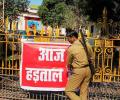
Banking services, particularly at public sector banks across India, were impacted by a nationwide strike called by the United Forum of Bank Unions (UFBU) to demand the immediate implementation of a five-day workweek and resolution of pending wage-related issues.

Delhi Police have dismantled a sophisticated cyber fraud network that allegedly used 37 mule bank accounts to siphon off Rs 7.36 crore from 99 complaints nationwide. Six individuals, including two bank branch managers and four sales staff, have been arrested for their alleged involvement in opening accounts with forged documents and converting illicit funds into cryptocurrency.
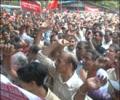
Normal banking operations were affected on Wednesday as the Left-leaning bank employees went on a one-day nation-wide strike to protest the proposed merger of the State Bank of Indore with its parent SBI.

Bank employees are planning to go on strike on December 16 during the Parliament Session against banking sector reforms such as privatisation of public sector banks (PSBs) and closure and merger of associate banks/other PSBs with State Bank of India.

The unions have also threatened to explore an indefinite strike option, if their demands were not addressed.

A special CBI court in Mumbai denied bail to Sandeep Mistry, an associate of fugitive businessman Nirav Modi, in the multi-million-dollar Punjab National Bank (PNB) scam. The court cited Mistry's history of destroying evidence and his absconding for seven years as reasons for the denial, expressing concerns about securing his presence during the trial if released.

Ahmedabad Cyber Crime Branch has uncovered a Rs 1.5 crore WhatsApp fraud, leading to the arrest of two key SIM and OTP suppliers in West Bengal. The investigation revealed a sophisticated international cybercrime network spanning China, Pakistan, India, and Hong Kong, operating a "boss scam" and utilizing a "Cybercrime as a Service" model. Police recovered a significant portion of the defrauded amount and secured thousands of devices.
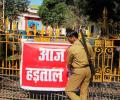
Banking operations at public sector banks across the country were impacted on Tuesday as the United Forum of Bank Unions (UFBU) went on nationwide strike demanding the immediate implementation of a five-day work week.

Govind Dev Giri Maharaj, treasurer of the Shri Ram Janmabhoomi Teerth Kshetra Trust, acknowledged supervisory lapses at the Ayodhya Ram temple following alleged donation theft, but stated he would not resign as he does not consider himself personally at fault. He estimated the theft could be around Rs 3 crore and criticised SBI for not verifying employee credentials.
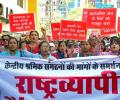
Bank unions on Friday deferred their two-day nationwide strike beginning Monday after they received positive assurance from both the finance ministry and the IBA on their demands, including a five-day work week and adequate recruitment in all cadres. The strike call for March 24 and 25 was given by United Forum of Bank Unions (UFBU), an umbrella organisation of nine bank employees' association.
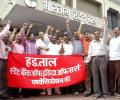
The United Forum of Bank Unions (UFBU) on Thursday said its two-day nationwide strike on March 24 and 25 will be observed as scheduled since discussions with the Indian Banks' Association (IBA) over key demands failed to yield any positive outcome. In a meeting with the IBA, all UFBU constituents raised issues, including recruitment in all cadres and a five-day workweek.
The unions have called for a strike against proposed closure of associate banks and their merger with the State Bank of India

'An instruction came from somebody in Delhi saying, "don't go with the launch".'
The Enforcement Directorate (ED) conducted searches in Jaisalmer, Rajasthan, investigating the alleged misuse of Rs 5.10 crore in foreign donations from a non-FCRA registered Belgian entity for proselytisation activities. Two local residents are accused of receiving funds without proper registration, disguising them as educational or cultural services, and using them to influence vulnerable communities.

Normal banking operations like cheque clearance in public sector banks across the country are likely to be hit on Wednesday as employees have decided to go on one-day nation-wide strike to press for wage revision.

Employees of public sector banks (PSBs) on Thursday went on two-day strike against the move to privatise public sector banks impacting normal banking operation across the country. Many branches across different parts of the country were shut as the United Forum of Bank Union (UFBU), an umbrella body of nine bank unions including All India Bank Officers' Confederation (AIBOC), All India Bank Employees Association (AIBEA) and National Organisation of Bank Workers (NOBW) had given two day strike call. As a result, services such as deposits and withdrawal at branches, cheque clearance and loan approvals might be affected due to the strike. But ATMs are expected to function as usual.

According to Association officials, Indian Banks' Association offered only a 11.5 per cent increase in hike compared to 17.5 per cent offered in 2011-12.

A Special Investigation Team (SIT) probing the alleged embezzlement of donation money at the Ram Temple in Ayodhya is expected to question people associated with the Shri Ram Janmabhoomi Teerth Kshetra Trust and review banking arrangements for donations.

If the new MDR regime is rolled out from the middle of this month, as scheduled, it should count as one of the boldest political actions by the Modi government on an economic-policy issue, and a signal that it is less worried about erosion of political capital it draws from one of its key constituencies, notes A K Bhattacharya.

Employees of four bank unions participating in strike are from All India Bank Employees Association, Bank Employees Federation of India, All India Bank Officers' Association and National Union of Bank Employees.

The All India Bank Employees Association had called for a strike on June 24,

The search for N Chandrasekaran's successor as Tata Sons Chairman has reportedly narrowed to Tata Steel CEO T V Narendran, Tata Sons Executive Director Saurabh Agrawal, and NSE MD & CEO Ashish Chauhan, with Chauhan emerging as a potential 'dark horse' candidate.

Over 8.5 lakh employees, majorly from public sector banks (PSBs), will get a 15 per cent hike in pay, with the conclusion of the 11th Bipartite Wage Negotiations on Wednesday. After three years of intense negotiations, the UFBU, which represents four bank officer associations and five workman unions, and the IBA on July 22 entered into a memorandum of understanding (MoU) for an annual wage hike of 15 per cent.

The Reserve Bank of India (RBI) has extended the implementation date for its revised loan recovery and agent engagement directions to January 1, 2027, from the previously proposed October 1, 2026, following stakeholder feedback.

Bank employees' unions have decided go on a day-long strike on January 7 across the country to press for a wage hike. Bank unions have also threatened to go on strike on multiple days later this month if their demand is not accepted.

Nepal's devastating flash floods have claimed 1,127 lives, with thousands still missing a week after the disaster. Rescuers are intensifying efforts to find survivors and recover bodies across affected regions, while police work to identify victims and relocate families from high-risk areas.

The United Forum of Bank Unions (UFBU), an umbrella body of nine unions, has given a call for a two-day strike from December 16 to protest against the proposed privatisation of two state-owned lenders. In the Union Budget presented in February, Finance Minister Nirmala Sitharaman had announced the privatisation of two public sector banks (PSBs) as part of its disinvestment plan. The government has already privatised IDBI Bank by selling its majority stake in the lender to LIC in 2019 and merged 14 public sector banks in the past four years.

In a move aimed at curbing the mis-selling of financial products, the Reserve Bank of India (RBI) has proposed banning incentives paid to bank staffers by third parties such as insurance companies and mutual fund houses for selling their products and services. It has also proposed that banks must ensure their user interfaces do not deploy "dark patterns" to lure customers.

Abusive language, threats, harassment, excessive or anonymous calls, public humiliation, and misleading representations are explicitly prohibited.
United Forum of Bank Unions (UFBU), an umbrella body of nine unions, has given a call for a two-day strike from March 15 to protest against the proposed privatisation of two state-owned lenders. In the Union Budget presented last month, Finance Minister Nirmala Sitharaman had announced the privatisation of two public sector banks (PSBs) as part of its disinvestment plan. The government has already privatised IDBI Bank by selling its majority stake in the lender to LIC in 2019 and merged 14 public sector banks in the last four years.

A property near Heathrow Airport, London, worth Rs 7.5 crore has been attached by the Enforcement Directorate (ED) in connection with a bank loan fraud case involving Neo Corp International Ltd.

The staff of public sector banks had gone on a nationwide strike for two days beginning February 10 after discussions with the IBA failed.
Services such as deposits and withdrawal at branches, cheque clearance and loan approvals would be affected due to the strike.
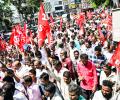
A nationwide strike called by trade unions to protest against the central government's labor policies had a mixed impact across India. While normal life remained largely unaffected in most parts of the country, some sectors like banking, transport, and insurance experienced disruptions. Sporadic incidents of violence were reported in West Bengal.
The United Forum of Bank Unions (UFBU), an umbrella body of nine unions, on Tuesday gave a call for a two-day strike from March 15 to protest against the proposed privatisation of two state-owned lenders. In the Union Budget presented last week, Finance Minister Nirmala Sitharaman announced the privatisation of two Public Sector Banks (PSBs) as part of its disinvestment plan. The government has already privatised IDBI Bank by selling its majority stake in the lender to LIC in 2019 and merged 14 public sector banks in the last four years.
The Reserve Bank of India (RBI) has unveiled draft norms for branch authorisation and business correspondents (BCs), introducing a two-tiered classification for BCs and redefining 'banking outlets' to include BC-Banking Outlets (BC-BOs), aiming to expand formal banking presence, particularly in rural areas.

India's privatisation push, once projected as a cornerstone of economic reform, has suffered another setback, with the Centre set to call off the IDBI Bank stake sale, highlighting the political and structural constraints shaping the country's disinvestment policy, experts say.
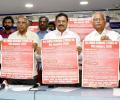
Most of the lenders had informed their customers in advance about the strike call given by All India Bank Employees Association (AIBEA), All India Bank Officers' Association (AIBOA), BEFI, INBEF, INBOC and Bank Karmachari Sena Mahasangh (BKSM), and its impact on banking services.
At a time when the finance ministry is focusing on addressing employee grievances, the number of employees in most public-sector banks (PSBs) has declined over the last three financial years.
